Quick Answer: Is Scaling Harmful?
No, professional dental scaling does not damage teeth or strip enamel. Ultrasonic tips vibrate at high frequencies to shatter hardened bacterial calculus (tartar) while leaving tooth enamel unharmed. Sensations of "loose teeth" or "new gaps" occur only because thick tartar that was previously masking severe bone loss has been removed.
One of the most persistent questions patients ask our clinicians in DHA Phase 5, Karachi is: does scaling damage teeth or make them permanently loose? Across Reddit threads, family gatherings, and community discussions in Pakistan, an ingrained myth persists that visiting a dental clinic for a routine cleaning will strip away enamel, create permanent gaps, and lead to early tooth loss.
This widespread misconception leads thousands of individuals to avoid essential preventive care, transforming easily manageable plaque into severe periodontitis (pyorrhea), chronic bleeding gums, and avoidable extractions. To understand why your teeth feel different after a cleaning, we must examine the biological reality of enamel, calculus, and periodontal architecture.
Does Scaling Damage Teeth? Unpacking the Most Common Pakistani Dental Myth
To answer whether a routine dental cleaning can harm your dentition, consider the anatomical strength of human teeth. Tooth enamel is the hardest biological substance in the human body, consisting of approximately 96% hydroxyapatite mineral crystals. It is significantly harder than bone and even tougher than steel.
When you eat, food particles, salivary proteins, and oral bacteria combine to create a sticky, colorless film known as dental plaque. If not thoroughly flossed and brushed away within 24 to 48 hours, plaque absorbs calcium and phosphate salts from your saliva, calcifying into rock-hard dental calculus (tartar). Once tartar forms, no manual toothbrush, herbal paste, or home remedy can dislodge it.
Because calculus is softer than enamel, modern dental cleaning instruments are calibrated to shatter only the calcified deposits without abrading the crystalline enamel shield underneath. The fear that cleaning strips enamel stems entirely from confusing the removal of toxic buildup with the removal of tooth structure.
The "Loose Teeth" Mystery: Why Tartar Acts as False Cement
The single most alarming complaint voiced on forums like r/karachi is: "My teeth were completely stable before scaling, but now they feel wiggly and loose!"
The clinical truth is surprising: scaling did not loosen your teeth; it revealed bone destruction that had already taken place.
The "Splint Effect" Explained
When calculus accumulates along the gumline over several years, bacteria release toxins that destroy the underlying alveolar bone and periodontal ligament fibers. As the bone melts away, hardened tartar fills the space, forming an uninterrupted, concrete-like bridge (splint) binding adjacent teeth together. When an ultrasonic scaler clears this infected mass, the artificial support vanishes, exposing the true, underlying tooth mobility.
Leaving calculus in place to hold teeth together is catastrophic. The live bacterial colonies within the tartar continue to eat away at the remaining bone until the teeth suddenly fall out completely. Removing calculus gives your gums an opportunity to heal, tighten, and reattach around the root surfaces.
Why Gaps & Sensitivity Appear After Cleaning
Two other widespread post-cleaning observations frequently cause unnecessary panic:
1. "Black Triangles" and Gaps Between Teeth
Patients often look in the mirror after scaling and notice triangular gaps between their lower front teeth. These spaces are not caused by the scaler pushing teeth apart. In reality, inflamed, swollen gums and thick tartar slabs were occupying that space. Once the infection is eliminated, the gums shrink back to their healthy, non-inflamed contours, revealing the natural gaps created by previous gum recession.
2. Temporary Cold & Hot Sensitivity
For months or years, thick calculus acts like a thermal winter coat over your tooth roots. When this blanket is removed, the tooth root is abruptly exposed to cold ice water, steaming chai, and air. This sensitivity is completely temporary and typically subsides within 48 to 72 hours as the tooth remineralizes. Applying a potassium nitrate or fluoride desensitizing paste rapidly resolves discomfort.
The Physics of Ultrasonic Scalers: How They Protect Enamel
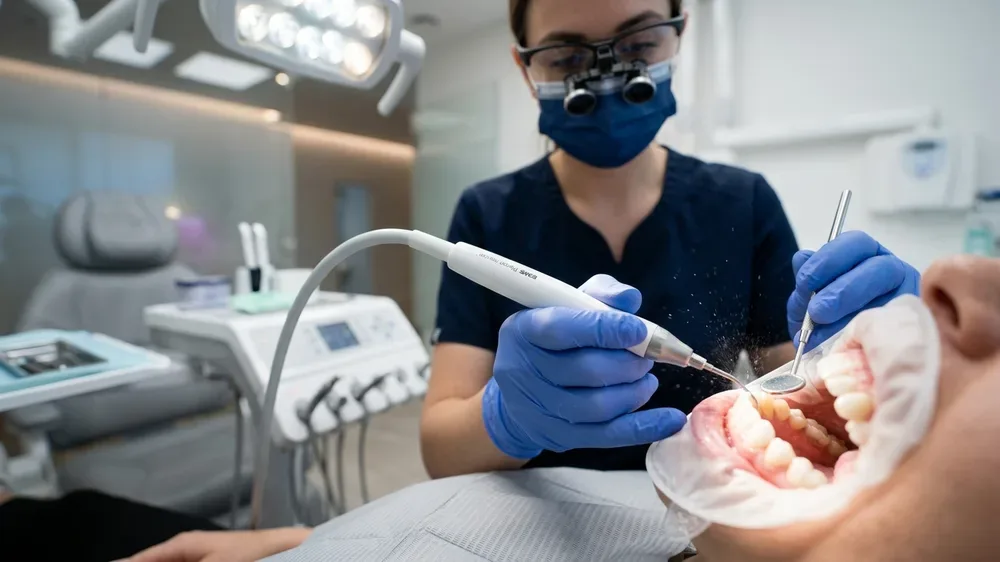
Decades ago, dental cleanings were performed solely with sharp manual hand scalers that required muscular scraping. Today, leading clinics utilize advanced piezoelectric and magnetostrictive ultrasonic scalers.
- Micro-Vibrations (25,000 to 45,000 Hz): The blunt tip does not rotate or cut like a drill. Instead, it oscillates at ultrasonic frequencies to shatter brittle calculus bonds effortlessly.
- Acoustic Cavitation: Pressurized sterile water streams create microscopic bubbles that implode against bacterial cell walls, destroying anaerobic bacteria even below the gum margin.
- Polishing Finish: Following scaling, a gentle rotating rubber cup with fine fluoride prophylaxis paste smooths microscopic enamel irregularities, leaving a glass-like finish that repels new plaque adhesion.
Myths vs. Clinical Facts Comparison
To summarize how clinical science disproves popular folklore, review this comparative breakdown:
| Common Pakistani Myth | Clinical Biological Reality | Outcome of Proper Care |
|---|---|---|
| "Scaling scratches and thins out enamel" | Enamel is far harder than ultrasonic tips. Scalers shatter softer tartar deposits without cutting enamel. | 100% enamel preservation |
| "Cleaning makes teeth shaky and loose" | Tartar acted as an infected temporary splint over bone loss. Removal exposes existing damage so gums can heal. | Stops irreversible bone loss |
| "Scaling creates wide gaps between teeth" | Tartar and inflamed gum tissue occupied the spaces. Clean gums tighten and reveal natural contours. | Eliminates chronic gum bleeding |
| "Sensitivity after cleaning means permanent damage" | Temporary nerve sensitivity from exposed roots previously covered by tartar. Fades within 2–5 days. | Fresh breath & healthy oral flora |
| "One cleaning is enough for a lifetime" | Salivary minerals constantly form new plaque. Cleanings are required every 6 months to maintain health. | Lifetime tooth retention |
"In our DHA Phase 5 practice, we frequently treat patients who avoided cleanings for a decade due to fear. By the time they arrive with mobile incisors, severe bone resorption has occurred. Scaling does not damage teeth; delaying your cleaning is what causes tooth loss."
— Dr. Shahid Islam (Principal Dental Surgeon, PMDC Registered)
What Happens When You Avoid Scaling in Pakistan?
In Pakistan, dietary factors such as strong sweetened milk tea (chai), paan, gutka, naswar, and tobacco accelerate stain and tartar formation. When professional cleanings are neglected, the progression follows a predictable path:
- Gingivitis (Reversible): Gums become red, swollen, and bleed upon brushing. Chronic bad breath (halitosis) develops as anaerobic bacteria proliferate.
- Periodontitis (Irreversible Bone Resorption): Infection migrates beneath the gumline, dissolving the alveolar bone socket. Deep periodontal pockets form, harboring destructive pathogens.
- Systemic Complications: Periodontal bacteria enter the bloodstream, elevating cardiovascular risk and complicating glycemic control for diabetic patients.
- Tooth Loss: Deprived of bone support, healthy, cavity-free teeth become loose and eventually require extraction followed by costly dental implants or bridges.
Preventive maintenance with routine scaling and polishing costs a fraction of advanced surgical or restorative care. If you are wondering about current fees in Karachi, read our transparent breakdown on teeth scaling and polishing costs in Pakistan.
Frequently Asked Questions
No. Professional ultrasonic scaling uses micro-vibrations and water irrigation to detach hardened calculus (tartar). It does not cut or scrape away healthy enamel, which is the hardest biological tissue in the human body.
Scaling does not cause teeth to loosen; it unmasks preexisting bone loss. When severe tartar builds up over years, it acts as a rigid, artificial bridge between diseased teeth. Once cleaned, the true underlying gum disease is exposed, allowing treatment to begin.
The gaps were already present due to swollen gums and gum recession caused by tartar. When hardened plaque is removed and inflammation subsides, the natural spaces between the teeth simply become visible.
Mild sensitivity to cold or hot liquids typically resolves within 2 to 5 days. It occurs because newly cleaned tooth surfaces and roots were previously insulated by calculus. Using a desensitizing toothpaste quickly alleviates this.
Most healthy adults require scaling and polishing once every 6 months. Patients prone to heavy tea, coffee, or paan staining, or those managing diabetes or periodontitis, benefit from cleanings every 3 to 4 months.
Protect Your Teeth with Gentle, Modern Cleaning
Experience pain-free ultrasonic scaling and hospital-grade sterilization at our DHA Phase 5 clinic in Karachi.