⚠️ Why This Matters
Pakistan has one of the highest prevalences of Hepatitis C in the world, approximately 7 to 8 million Pakistanis are infected. Poor sterilization practices at medical and dental facilities have historically been a contributing factor. This guide helps you make an informed, safe choice.
On Reddit's r/karachi and r/pakistan forums, this question comes up repeatedly: "Is it safe to go to a dentist in Karachi? Can I get hepatitis from dental instruments?" It is a legitimate concern, and one that deserves a thorough, honest answer.
The short answer is: Yes, dental treatment in Karachi is completely safe, if you choose a clinic that operates to international infection control standards. The risk exists only in facilities that cut corners on sterilization. Here is exactly what those standards look like.
What is Class-B Autoclave Sterilization?
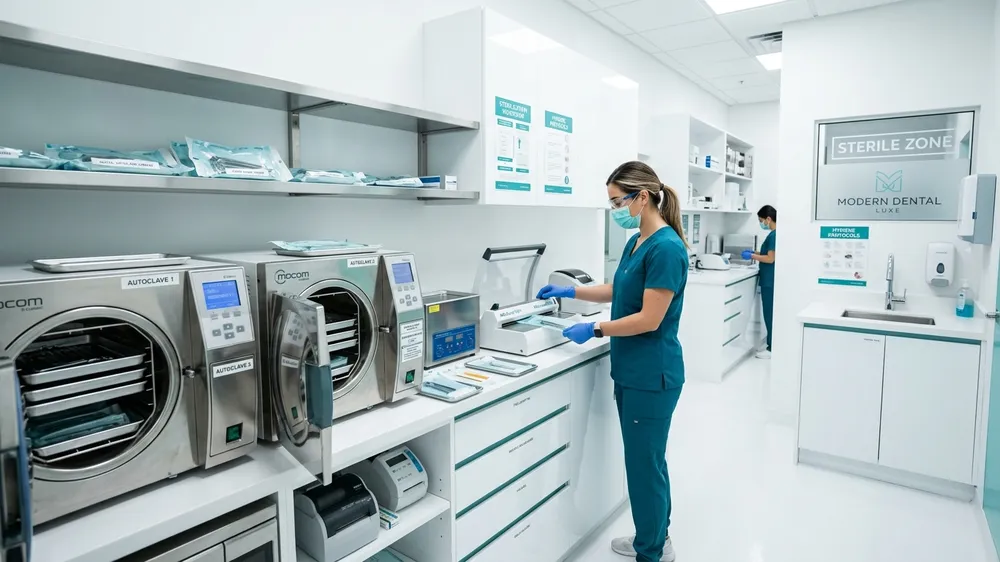
The gold standard for sterilizing dental instruments is the Class-B pre-vacuum autoclave. Here is how it works:
- Pre-Vacuum Cycle: All air is evacuated from the chamber under vacuum. This allows steam to penetrate every surface of every instrument, including hollow lumens like handpieces and endodontic files.
- Steam Sterilization: Pressurized saturated steam at 134°C for 18 minutes eliminates 100% of bacteria, viruses (including Hepatitis B, C, and HIV), and bacterial spores.
- Post-Vacuum Drying: A drying phase removes residual moisture, preventing re-contamination inside sealed pouches.
- Chemical Indicators: Every sealed pouch contains a chemical strip that changes colour only when the correct temperature and time combination has been achieved, providing visual proof of sterilization.
"A standard Class-N autoclave (common in many Pakistani clinics) does not achieve full pre-vacuum, meaning it cannot properly sterilize hollow instruments like handpieces. A Class-B autoclave is the minimum standard required in the UK, EU, and Australia. It is the standard we have adhered to since day one."
, Dr. Shahid Islam
Our 8-Step Infection Control Protocol at DHA Phase 5
- Single-Use Needles & Cartridges: Every anesthetic needle and cartridge is used once and disposed of in a sharps bin in front of the patient. No exceptions.
- Single-Use Suction Tips & Saliva Ejectors: Discarded after each appointment.
- Instrument Pouching: All reusable instruments are individually sealed in labelled sterilization pouches with chemical indicators before autoclaving.
- Class-B Autoclave Validation: Our autoclave undergoes weekly biological spore testing (Helix test) to verify penetration into hollow instruments.
- Surface Barrier Protocols: All chair surfaces, light handles, and bracket tables are covered with disposable barrier film changed between every patient.
- Fresh Gloves Per Patient: New sterile gloves are opened in front of each patient. Gloves are never worn between two patients.
- High-Level Disinfection for Non-Autoclavable Items: Items that cannot withstand autoclave temperatures are disinfected with hospital-grade Glutaraldehyde or equivalent FDA-approved solutions.
- Staff Vaccination: All clinical staff are fully vaccinated against Hepatitis B and undergo regular blood-borne pathogen training.
5 Questions to Ask Any Dentist Before Treatment
When visiting a new dental clinic in Karachi, you have every right to ask these questions. A qualified, ethical dentist will welcome them:
- 🔬 Do you use a Class-B (pre-vacuum) autoclave? Ask to see the machine.
- 🩺 Are instruments individually pouched with chemical indicators? Ask to see an unopened pouch.
- 💉 Are needles and syringes always new and single-use? They should open them in front of you.
- 🧤 Do you change gloves between every patient? Observe the pre-appointment hand-washing and gloving ritual.
- 📋 Do you have a written infection control policy? Clinics meeting international standards will have one.
6 Red Flags: Walk Away From Any Clinic That...
- ❌ Stores used instruments in an open tray without pouching
- ❌ Reuses or "wipes down" disposable suction tips between patients
- ❌ Cannot show you a functioning autoclave on the premises
- ❌ Uses the same gloves across multiple patients
- ❌ Becomes defensive or dismissive when asked about sterilization
- ❌ Does not change the chair cover or wipe down surfaces between patients
Frequently Asked Questions
With 100% single-use needles, the risk is zero. Hepatitis C transmission requires direct blood-to-blood contact via a contaminated needle or instrument. At our clinic, every anesthetic needle is opened from a sealed sterile pack in front of the patient and disposed of immediately in a sharps bin. There is no reuse whatsoever.
A Class-N (gravity displacement) autoclave relies on gravity alone to remove air, it cannot sterilize hollow dental instruments like rotary handpieces or root canal files effectively. A Class-B pre-vacuum autoclave uses a pump to actively remove all air before steam entry, guaranteeing complete penetration. The EU EN 13060 standard mandates Class-B for all dental instruments. Many Pakistani clinics still use Class-N machines, which are inadequate for full dental sterilization.
Absolutely, if you choose the right clinic. Dr. Shahid Islam trained in the UK and has implemented CQC-compliant infection control protocols at our DHA Phase 5 clinic. We specifically welcome and serve UK, USA, Canada, and Gulf-based Pakistani patients who want to combine dental treatment with a family visit. We can provide pre-arrival assessments and detailed clinical documentation for your UK dental records.
🛡️ Your Safety is Our Priority
Visit our clinic in DHA Phase 5 and see our sterilization suite first-hand before your first treatment.