Quick Answer: Dental Crown Prices in Karachi
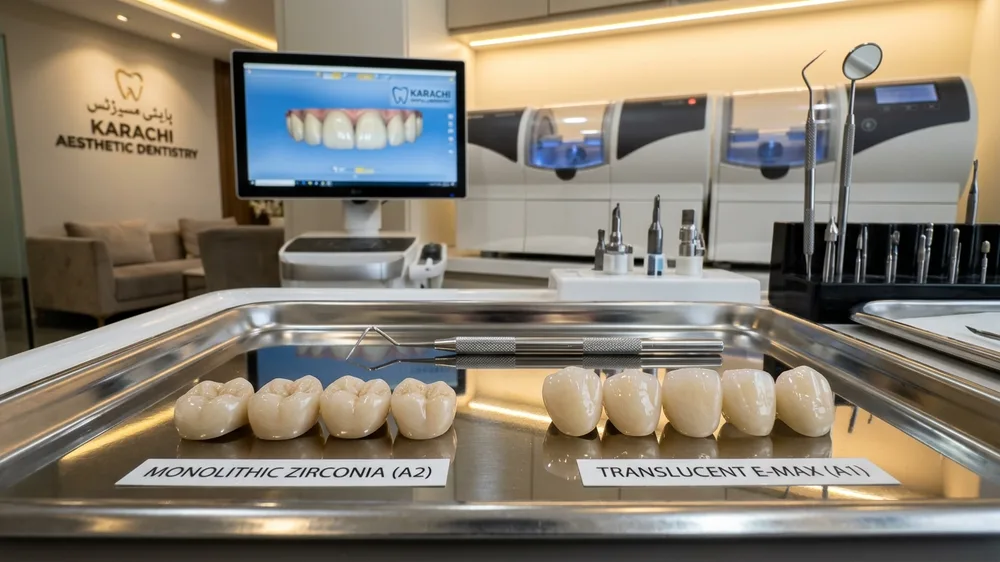
A dental crown in Karachi costs between PKR 8,000 and PKR 45,000 per tooth. Basic PFM metal crowns cost PKR 8,000–15,000. Monolithic CAD/CAM Zirconia crowns (ideal for back molars) range from PKR 18,000–35,000. Premium aesthetic E-Max ceramic crowns (ideal for front teeth) range from PKR 25,000–45,000.
When restoring a broken tooth or protecting a tooth after endodontic therapy, understanding the true dental crown cost in karachi helps patients choose between strength, lifelike aesthetics, and long-term durability. Whether you recently completed a root canal in DHA Phase 5 or cracked a molar on a piece of bone, placing a custom dental cap is the final, essential step to prevent catastrophic tooth fracture.
However, patients browsing online forums or visiting clinics often encounter vastly different fee quotations. A cheap crown can leave an ugly grey line at your gumline or chip within three years, while an engineered German CAD/CAM ceramic crown can comfortably last 20 to 25 years. Here is a transparent clinical breakdown of materials, laboratory artistry, and pricing in Pakistan.
Dental Crown Cost in Karachi: Material Breakdown & Price Comparison
In Karachi's dental landscape, crown pricing reflects the raw ingot material (imported from Germany, Switzerland, or Japan), the precision of 3D CAD/CAM optical scanning, and the dental technician's manual ceramic layering skill:
| Crown Material | Typical Cost in Karachi (PKR) | Strength (MPa) | Ideal Location in Mouth |
|---|---|---|---|
| Monolithic Multi-Layer Zirconia | PKR 18,000 – 35,000 | 1,100 – 1,250 MPa (Unbreakable) | Back Molars & Premolars (Heavy chewers) |
| E-Max (Lithium Disilicate) | PKR 25,000 – 45,000 | 400 – 500 MPa | Front Incisors & Canine Smile Zone |
| Porcelain-Fused-to-Metal (PFM) | PKR 8,000 – 15,000 | 450 MPa (Porcelain veneer layer) | Budget restorations (Hidden posterior) |
| Temporary Acrylic / PMMA Crown | PKR 2,500 – 5,000 | 80 – 100 MPa | Interim protection during lab fabrication |
Zirconia Crowns: The Unbreakable Standard for Molars
Zirconium dioxide is a biocompatible white crystalline ceramic renowned for its extreme mechanical resistance. It is virtually indestructible under human masticatory force:
- Fracture Resistance: While older ceramics can chip on hard nuts or crispy food, monolithic Zirconia does not chip or fracture even under 1,200 MPa of pressure.
- Conservative Tooth Reduction: Because Zirconia is exceptionally durable even at thin margins (0.6mm), the dentist needs to shave away significantly less natural tooth structure compared to older crowns.
- Multi-Layer Gradient Aesthetics: Modern Zirconia is no longer chalky white. It features a natural color gradient: dense opaque ivory at the cervical margin blending into lifelike translucency at the biting edge.
E-Max Ceramic Crowns: Maximum Natural Translucency
For teeth in the prominent "smile line" (upper front central incisors, laterals, and canines), IPS e.max Lithium Disilicate is the global gold standard:
- Chameleon Effect: E-Max possesses the exact same optical refractive index as natural human enamel. When light hits an E-Max crown in daylight or flash photography, it passes partially through the ceramic, reflecting off internal dentin just like a real tooth.
- Precision Bonding: E-Max is chemically etched with hydrofluoric acid and resin-bonded directly to the tooth substrate, creating a monolithic seal that prevents bacterial leakage and decay.
The Flaws of Older PFM (Porcelain-Fused-to-Metal) Crowns
For over forty years, PFM crowns were the standard restoration across Pakistan. However, modern prosthodontics has largely phased them out due to inherent aesthetic and biological drawbacks:
Why Older PFM Crowns Cause the "Dark Gumline"
PFM crowns require a grey nickel-chromium or cobalt-chromium metal thimble beneath the porcelain to provide rigidity. To hide this dark metal, an artificial chalky opaquer is painted over it. Over time, natural gum maturation or minor gum recession exposes the black metal collar at the margin, creating an unsightly dark ring that makes the tooth look dead.
Furthermore, the outer porcelain layer on a PFM crown is mechanically bonded to metal, making it vulnerable to chipping off when you bite into tough meat or hard bread, exposing the grey metal beneath.
"At our DHA Phase 5 clinic, we strictly use metal-free monolithic Zirconia and E-max restorations. Patients frequently come to us to replace 10-year-old PFM crowns that have black margins or chipped porcelain. Investing in a CAD/CAM all-ceramic crown eliminates dark lines permanently."
— Dr. Shahid Islam (Principal Dental Surgeon, PMDC Registered)
Why You Need a Crown After a Root Canal
A common mistake patients make after completing a painless root canal treatment is skipping the crown to save money. This frequently results in losing the tooth entirely:
- Loss of Internal Moisture: When the infected dental pulp (nerve and blood vessels) is cleared, the remaining dentin dehydrates, becoming brittle like dried wood.
- Structural Cavity Loss: Deep decay that reached the pulp usually robs the tooth of 40% to 60% of its natural enamel walls.
- Vertical Root Fracture: Chewing forces on back molars reach up to 200 pounds per square inch. Without a 360-degree crown encircling the tooth (the "ferrule effect"), an uncovered molar will split vertically straight down the middle, making tooth extraction unavoidable.
Protecting your tooth with a crown preserves your investment and saves you from needing a much more expensive dental implant. Read our detailed guide on root canal costs in Karachi to understand the full restorative timeline.
Frequently Asked Questions
In Karachi, PFM (Porcelain-Fused-to-Metal) crowns range from PKR 8,000 to PKR 15,000. Monolithic multilayer Zirconia crowns cost between PKR 18,000 and PKR 35,000. Premium cosmetic E-max lithium disilicate crowns range from PKR 25,000 to PKR 45,000 per tooth.
Monolithic Zirconia is the undisputed gold standard for back molars. With a flexural strength exceeding 1,100 to 1,200 MPa, Zirconia withstands extreme chewing and grinding forces without chipping. E-Max (400–500 MPa) is superior for front incisors where translucency and light reflection matter most.
PFM crowns feature an opaque metal sub-structure coated with porcelain. Over time, natural gum recession exposes the dark metal collar at the margin. Modern all-ceramic Zirconia and E-max crowns have zero metal, guaranteeing natural translucency even if gums recede.
For posterior teeth (molars and premolars), yes. A root canal removes the tooth's internal blood supply, leaving the enamel brittle and prone to vertical fracture under chewing pressure. A crown protects the tooth like a helmet, ensuring it lasts for decades.
A precisely fabricated CAD/CAM Zirconia or E-max crown typically lasts 15 to 25+ years with routine flossing, daily brushing, and biannual dental scaling. Good oral hygiene prevents recurrent decay at the crown margin.
Restore Your Broken Tooth with Precision CAD/CAM Crowns
Get exact shade matching, 10-year warranties, and biocompatible all-ceramic crowns in DHA Phase 5, Karachi.